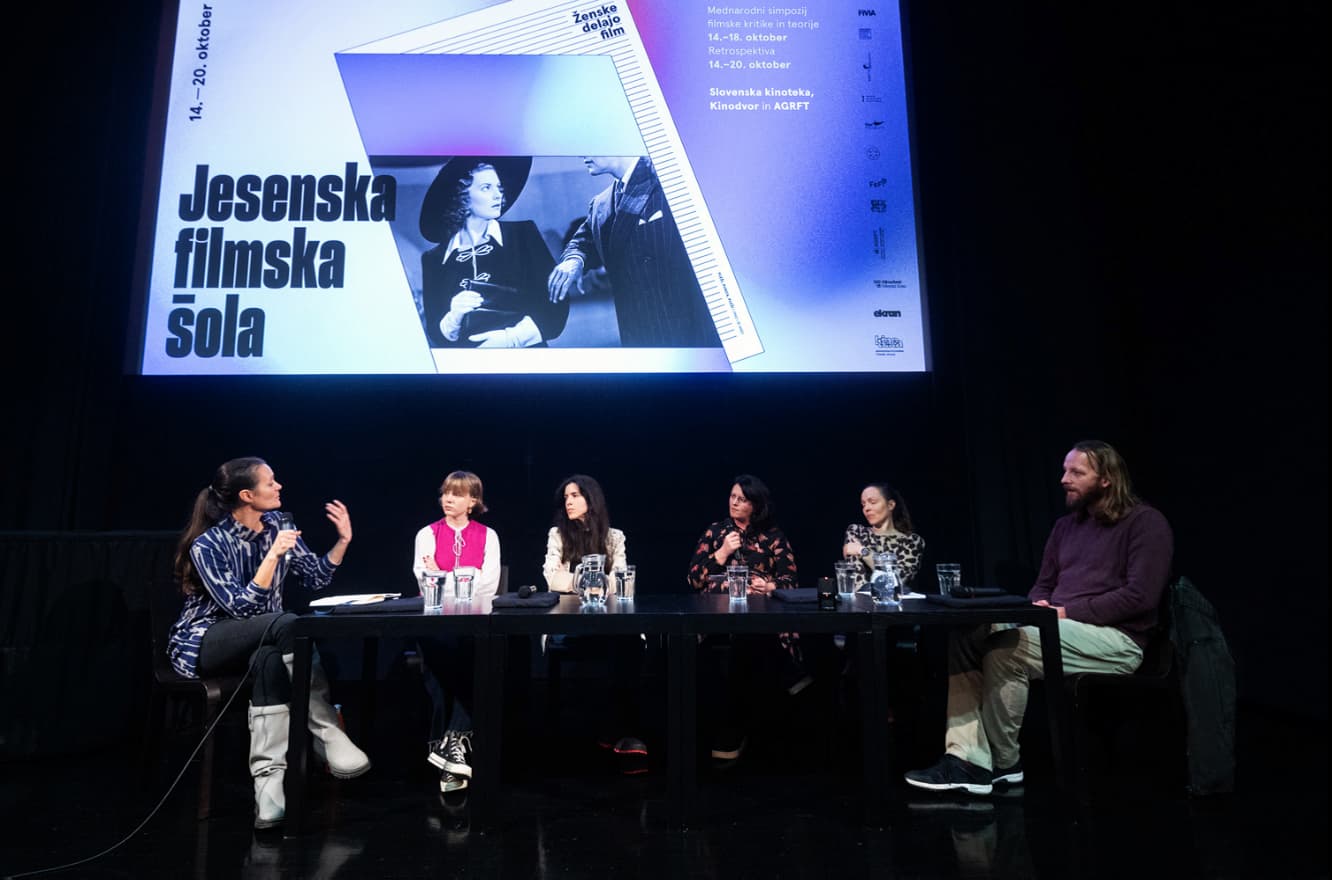
The International Symposium of Film Theory and Practice, Autumn Film School (Jesenska filmska šola – JFŠ), has been bringing together theoretical, political, aesthetic, and socio-historical reflections on film and film culture since 1985. It is one of the Slovenian Cinematheque’s most theoretically in-depth programmes, addressing socially and culturally relevant topics in film art through lectures, discussions, presentations, round tables, and film screenings prepared by Slovenian and international experts.
CURRENT UPDATE: There will be no Autumn Film School in 2026. We will return in February 2027 in a refreshed format and under a new name: Winter Film School. The subtitle of the next symposium will be A Century of Sound, marking the centenary of the transition from silent to sound film. The broad and multifaceted field of film sound will be explored through a variety of perspectives, ranging from aesthetic and cultural approaches to technical and technological viewpoints. The symposium will feature lectures by film theorists and historians, as well as practitioners working in film sound design and music composition for silent film.
Autumn Film School Archive
The Autumn Film School titled Women Make Film (14–20 October 2024) opened up feminist perspectives for the first time in its history. Through them, we reflected on contemporary theoretical currents, explored the work of selected women filmmakers, examined the socio-political engagement of images and discourses, and addressed marginalised and overlooked film forms such as home movies. In re-/writing film history, we also considered the role of film archives and curatorial practices in relation to traditional canons.
Symposium Programme:
- Lecture: Katja Čičigoj: Loudly Furious, Violently Resisting: A Cinematic Shift from Personal Revenge to Feminist Counterviolence.
- Lecture: Anne Misak: The Online Feminist Platform MAI: Empowering Women’s Voices.
- Lecture: Katja Stamboldžioski: Women Documentary Filmmakers at TV Ljubljana: The Path from Journalists to Screenwriters and Directors of Documentary Films.
- Lecture: Gaby Babić and Lou Deinhart (Kinothek Asta Nielsen):Returning to Feminist Film Work.
- Roundtable Discussion: How to Work and Act within the Patriarchal World of Film? Guests: Iva Babić, Sabina Đogić, Mateja Fajt, Tinkara Klipšteter. Moderators: Jana Burger and Žiga Brdnik.
- Conversation: Kumjana Novakova: Shaping New Collectivities. Moderator: Veronika Zakonjšek.
Film Programme:
78 Days (78 dana, 2024, Emilija Gašić) (Screening held at Kinodvor)
Cinematheque Focus: Cecilia Mangini
Cecilia and Agnès – A Dialogue on Reality (Cecilia e Agnès – Dialogo sulla realtà, 2023, Paolo Pisanelli)
The Song of the Marshes (La canta delle marane, 1961, Cecilia Mangini)
Maria and the Days (Maria e i giorni, 1960, Cecilia Mangini)
Being Women (Essere donna, 1965, Cecilia Mangini)
Coliseum (Kolizej, 1984, Žarko Lužnik)
Shorts!: Girlfriends’ Get-Together
When You See a Rose (Wenn du eine Rose siehst, 1995, Renate Sami)
Asta Nielsen as a Mannequin (Asta Nielsen als Mannequin, 1915)
Toto Bissainthe (1984, Sarah Maldoror)
Girlfriends’ Get-Together (Freundinnenfest, 1982, Regina Ulwer)
Illusions (1983, Julie Dash)
Carolee, Barbara and Gunvor (2018, Lynne Sachs)
Love Lies Bleeding (2024, Rose Glass)
Between Moon and Sun (Zwischen Mond und Sonne, 1981, Recha Jungmann)
Melody for a Street Organ (Melodija dlja šarmanki, 2009, Kira Muratova)
My Stolen Planet (Sayyareye dozdide shodeye man, 2024, Farahnaz Sharifi)
Negative Man (1985, Cathy Joritz)
Dance, Girl, Dance (1940, Dorothy Arzner)
Silence of Reason (2023, Kumjana Novakova)
Vukica Đilas – Home Movies (Diary Films; proposed by Pavle Levi), 1970–199? (edited by Slobodan Šijan, 2015) (Screening held at AGRFT). The screening was followed by a conversation between Milan Milosavljević (Academic Film Center Belgrade) and Dr Maja Kranjc (AGRFT).
The Ascent (Voshoždenie, 1977, Larisa Shepitko)
Disturbed Earth (2021, Kumjana Novakova, Guillermo Carreras Candi)
Autumn Film School 2023 (23–29 October 2023), organised on the occasion of the anniversaries of two key cinematic venues in Ljubljana – the 100th anniversary of Kinodvor, the city’s first purpose-built cinema, and the 60th anniversary of the hall that today houses the Slovenian Cinematheque – was held under the title We Watch Film, Film Watches Us. Through lectures, discussions, and roundtable conversations with local and international experts, as well as a retrospective programme focused on the multiplicity of cinema experience, the symposium reflected on new modes of viewing, the evolution of the image, the cultural logic of artificial intelligence, the changing paradigm of the film industry, and the redefinition of cinema as experience, technology, and architecture.
Symposium Programme:
- Conversation: Mark Cosgrove and Tara Judah: Curating and Community: In Defence of Independent Cinema.
- Lecture: Nina Cvar: The Cultural Logic of Artificial Intelligence in Film and Beyond.
- Lecture: Marina Gumzi – New “Comradeship”.
- Lecture: Ciril Oberstar and Martin Pogačar: The Power of “Unseeing”: Film, Literature, and the Limits of Vision.
- Andrej Šprah: The Assumption of the “End of Film” as a Pedagogical Potential for Returning to the Authenticity of Film Experience.
- Lecture: Mattias Frey: Algorithms and Audiences.
- Lecture: Oskar Ban Brejc: Immersion and Its Failure: Film and Technology.
- Roundtable Discussion: Cinema Rediscovered. Guests: Koen Van Daele, Marina Gumzi, Tara Judah, Igor Prassel. Moderator: Ana Šturm.
- Lecture: Mariya Nikiforova: Hybrid Forms: The Interweaving of Photochemical and Digital Practices in Contemporary Experimental Film.
- Lecture: Valerie Wolf Gang: Extended Reality (XR) and the Changing Paradigm of the Film Industry.
Film Programme:
2046 (Wong Kar-Wai, Hong Kong/China, 2004)
The Spirit of the Beehive (El espíritu de la colmena, Víctor Erice, Spain, 1973)
The Lost Boys (Joel Schumacher, USA, 1987)
King Kong (Merian C. Cooper, Ernest B. Schoedsack, USA, 1933)
Newsreel 670 – Red Forests (Obzornik 670 – Rdeči gozdovi, Obzorniška fronta, Slovenia, 2022)
Relations Between Objects – Programme of Short Films
Her Glacial Speed (Eve Heller, USA, 2001)
A Study in Natural Magic (Charlotte Pryce, USA, 2013)
Fire Child (Gordon Matta-Clark, USA, 1971)
Hus (Inger Lise Hansen, USA, 1998)
Alpsee (Matthias Müller, Germany, 1995)
Venus Delta (Antoinette Zwirchmayr, Austria, 2016)
Milk and Glass (Sarah Pucill, UK, 1993)
Self-Fulfilling Prophecy (Monika Schwitte, 1994)
Munich-Berlin Wanderung (München-Berlin Wanderung, Oskar Fischinger, Germany, 1927)
Oroslan (Matjaž Ivanišin, Slovenia/Czech Republic, 2019)
Mulholland Drive (David Lynch, USA/France, 2001)
Paris, Capital of the 20th Century – Programme of Short Films
Montparnasse (Eugène Deslaw, France, 1929–1930)
No Posters Allowed (Défense d’afficher, Hy Hirsh, France, 1958–1959)
Path of Signs (Allée des signes, Luc Meichler, Gisèle Rapp-Meichler, France, 1976–1977)
The Water of the Seine (L’Eau de la Seine, Teo Hernandez, France, 1982–1983)
Terminus for You (Nicolas Rey, France, 1996)
Kill Bill: Vol. 1 (Quentin Tarantino, USA, 2003)
Kill Bill: Vol. 2 (Quentin Tarantino, USA, 2004)
Enter the Dragon (Robert Clouse, Hong Kong/USA, 1973)
Last and First Men (Jóhann Jóhannsson, Iceland, 2020)
Goodbye, Dragon Inn (Bu san, Tsai Ming-liang, Taiwan, 2003)
Anything Can Happen (Wszystko może się przytrafić, Marcel Łoziński, Poland/Germany, 1995)
Autumn Film School 2022 (11–16 October 2022), organised on the occasion of the 60th anniversary of Ekran, the Slovenian magazine for film and television, was dedicated to film criticism and practices of film criticism. At a time seemingly hostile to criticism of any kind, the lectures, roundtable discussions, and film programme explored the current state of film criticism and film journalism both in Slovenia and internationally. How do accelerated digitisation and increasingly unsustainable material conditions coincide with an exceptional drive to invent new forms, tactics, and strategies? Where can the most radical forms of expression be found – those capable of revealing the blind spots of the past? Is criticism still capable of confronting the crises that threaten both itself and its world?
Symposium Programme:
- Lecture: The Third Gaze. Darko Štrajn.
- Round table: Ekran Before Screens – On the 60th Anniversary of Ekran, the Magazine for Film and Television.Participants: Anja Banko, Simon Popek, Majda Širca, Vlado Škafar, Marcel Štefančič, Jr., and Ana Šturm. Moderator: Stojan Pelko.
- Round table: Oppositional Perspectives – Art, Film, and Structures of Power. Participants: Špela Čadež, Natalija Majsova, Yoana Pavlova, and Daniella Shreir. Moderator: Petra Meterc. In English. In cooperation with City of Women.
- Lecture: Film on the Radio Waves. Anja Banko and Urban Tarman.
- Lecture: From the Personal to the Professional and Back Again. Dana Linssen and Yoana Pavlova.
- Lecture: Is Criticism Still Critical? Daniella Shreir and Missouri Williams.
- Round table: Critical Thinking vs. Critique in the Time of Forbidden Thought. Participants: Ana Geršak, Polona Petek, Missouri Williams, and Alenka Zupančič. Moderator: Anja Zag Golob.
Film programme:
Bringing Out the Dead (Martin Scorsese, ZDA, 1999)
The Night of the Hunter (Charles Laughton, ZDA, 1955)
Opozicijski (v)pogledi – program slovenskih kratkih filmov
Brainwashed: Sex-Camera-Power (Nina Menkes, ZDA, 2022)
Paris, Texas (Wim Wenders, ZDA/Francija/ZRN/VB, 1984)
The Souvenir (Joanna Hogg, VB/ZDA, 2019)
The Souvenir: Part II (Joanna Hogg, VB/ZDA, 2021)
Taxi Driver (Martin Scorsese, ZDA, 1976)
The Last Picture Show (Peter Bogdanovich, ZDA, 1971)
The aim of the symposium Film Culture in Educational Practice: Foundations and Methods of Teaching Film (19–20 October 2021) was to familiarise Slovenian educational professionals with theorists and practitioners from various parts of Europe who are deeply engaged either in the direct implementation of film education processes or in their theoretical study. The symposium featured a diverse group of international guests from different fields in which film is understood as an important component of cultural education.
Symposium Programme:
- Maja Kranjc: Opening Address.
- Lecture: Film Culture in School: Approaches and Methods of Teaching Film. Bettina Henzler.
- Lecture: Interdisciplinarity – A Way Out or the Purpose of Film Literacy Education in Schools? Polona Petek.
- Lecture: Context, Community, and Criticism in Film Education. Alexis Gibbs.
- Lecture: How to Analyse a Pedagogical Tool for Film Education? Perrine Boutin.
- Presentation: A School Day with Film: An Imaginary Timetable. Alejandro Bachmann.
- Lecture: One World in Schools – Learning through Documentary Films. Ida Vorhyzkova.
- Lecture: The Croatian Film Association’s Programme Filmska naSTAVa as an Example of Good Practice. Ana Đordić.
- Lecture: The Pedagogy of Film and through Film. Nuria Aidelman.
- Lecture: Teaching the Aesthetic Elements of Film Creativity. Andrej Šprah.
The symposium and retrospective of Autumn Film School 2019 focused on documentary film production in the territory of the former Yugoslavia. In the context of attempts to establish new forms of connection across different areas of life and artistic practice, this region has increasingly come to be described by the term “Yugosphere”.
Symposium Programme:
- Maja Kranjc: Opening Address.
- Lecture: The Cinematography of Re-enactment and Transcendence in the Work of Matjaž Ivanišin. Andrej Šprah.
- Lecture: The Transparency of a Documentary Expression. Andrej Tomažin.
- Lecture:Meditations on the Mediterranean of Boris Poljak. Višnja Vukašinović.
- Lecture: The “Cargo” of Depth Two. Maja Bogojević.
- Lecture: Bakhtin’s “State of Becoming…” as a Search for Identity in Post-Yugoslav Documentary Film.Magdalena Tutka-Gwóźdź.
- Lecture: Displaced from a Place That Once Existed: Post-Yugoslav Film Abroad. Kumjana Novakova.
- Round table: A Kaleidoscope of Reflected Identities in Documentaries from the “Yugosphere”. Vlado Škafar, Matjaž Ivanišin, Nebojša Slijepčević, Jelena Maksimović, Mihajlo Jevtić. Moderator: Maja Kranjc.
Film Programme:
Autofocus (Boris Poljak, Croatia, 2013)
Che Sara (Matjaž Ivanišin, Slovenia, 2002)
Tugboat Guardian (Čuvar tegljača, Silvio Mirošničenko, Croatia, 2003)
Tiny Bird (Sitna ptica, Dane Komljen, Croatia/Serbia, 2013)
Shot by Phone (Film mobitelom, Nedžad Begović, Bosnia and Herzegovina, 2011)
Depth Two (Dubina dva, Ognjen Glavonić, Serbia/France, 2016)
Karpopotnik (Matjaž Ivanišin, Slovenia, 2013)
Real Man’s Film (Muški film, Nebojša Slijepčević, Croatia, 2012)
They Just Come and Go (Oni samo dolaze i odlaze, Boris Poljak, Croatia, 2016)
The Old Bridge (Stari most, Vlado Škafar, Slovenia, 1998)
Split Watercolour (Splitski akvarel, Boris Poljak, Croatia, 2009)
Srbenka (Nebojša Slijepčević, Croatia, 2018)
Four Passports (Četiri pasoša, Mihajlo Jevtić, Germany/Serbia/Croatia, 2016)
Taurunum Boy (Jelena Maksimović, Dušan Grubin, Serbia, 2018)
Three (Tri, Goran Dević, Croatia, 2008)
On the 50th anniversary of the student and workers’ movements in Paris, Belgrade, Prague, and elsewhere across Europe, North America, and the world, Autumn Film School was dedicated to engaged non-fiction films produced in the very epicentres of the May protest movements, often under the guidance of activists and proletarian collectives. Rather than focusing on feature-length commercial cinema (which never truly managed to seriously confront the events of the summer of ’68), our attention turned to experimental, marginal, and often underground production that reached audiences outside established channels of distribution and professional exhibition.
Symposium Programme:
- Nace Zavrl: Opening Address and Symposium Opening.
- Lecture: Active Spectators, Political Actors: An Omission in Film Theory after May ’68. Mark Betz.
- Lecture: The Dziga Vertov Group in Palestine: Montage in Practice and Theory. Daniel Fairfax.
- Lecture: “Here and Elsewhere” in the Cinemas of 1968. Olivier Hadouchi.
- Lecture: The Prague Spring and Its Contribution to the Radicalisation of the Engaged Documentary. Andrej Šprah.
- Lecture: Ballet of Fluffy Death: Performance, Projection, and Protest in British Counterculture before 1968.Sophia Satchell-Baeza.
- Lecture: The Aesthetics and Revolutionary Potential of the Unfinished. Tara Najd Ahmadi.
- Lecture: The Separation of Separation: The Perpetual Search for the Image of Resistance or the Separation and Reversibility of the Heritage of the Utopian Militant Image of 1968. Nina Cvar.
- Lecture: The Filmic Truth of the Revolution of 1968. Darko Štrajn.
- Lecture: Cartography of the Event-Form: 1960–1980. Raquel Schefer.
- Lecture: From Joyful Science to Declarations of World War: Militant Upheavals of the Cinematic Apparatus and the Construction of New Audiovisual Assemblages after 1968. Michael N. Goddard.
Film Programme:
Class of Struggle (Classe de lutte, Groupe Medvedkine de Besançon, Chris Marker, France, 1969)
Black Days (Čierne dni, Ladislav Kudelka, Milan Černák, Štefan Kamenický, Ctibor Kováč, Czechoslovakia, 1968)
June Turmoil (Lipanjska gibanja, Želimir Žilnik, Yugoslavia, 1969)
Katzelmacher (Rainer Werner Fassbinder, West Germany, 1969)
The Red Army / PFLP: Declaration of World War (Sekai senso sengen, Masao Adachi, Koji Wakamatsu, Japan/Palestine, 1971)
Cuba Sí! (Chris Marker, France, 1961)
The Newborns (Teze-nafas-ha, Kianoush Ayari, Iran, 1979)
Oratorio for Prague (Oratorium pro Prahu, Jan Němec, Czechoslovakia, 1968)
Programme of Newsreels:
Summer ’68 (Newsreel No. 505, Norman Fruchter, John Douglas, USA, 1969)
Black Panther (Newsreel No. 19, San Francisco Newsreel, USA, 1968)
The Case of the Lincoln Center (Newsreel No. 17, Newsreel, USA, 1968)
Rebellion – With Noam Chomsky (Newsreel No. 1, Newsreel, USA, 1968)
Teorema (Pier Paolo Pasolini, Italy, 1968)
Entranced Earth (Terra em Transe, Glauber Rocha, Brazil, 1967)
At the core of Autumn Film School 2017 (24–26 October 2017) was the relationship between the Revolution and the transformations of Soviet cinema in the 1920s and 1930s. Methodological approaches to this relationship – a distinctly multidimensional field encompassing not only specifically cinematic issues, but also questions concerning the role of art in socialist society, the role of film representation in mediating history, as well as material and historical factors – necessarily differ greatly. Rather than investigating an isolated theme, such as film representations of October, the film school served as a probing ground for contemporary research possibilities.
Film Programme:
Besa (Srđan Karanović, Serbia, France, Croatia, Hungary, Slovenia, 2009)
Black Film (Crni film, Želimir Žilnik, Yugoslavia, 1971)
Flotel Europa (Vladimir Tomić, Denmark, Serbia, 2015)
Remembering the Others (Spominjanje drugih, Ana Čigon, Slovenia, Kosovo, 2015)
Newsreel 62 (Obzornik 62, Nika Autor, Slovenia, 2015)
The Border Post (Karaula, Rajko Grlić, Slovenia, 2006)
Serbia Year Zero (Serbie, année zéro, Goran Marković, France, Serbia, 2001)
Marble Ass (Dupe od mramora, Želimir Žilnik, Yugoslavia, 1995)
For Now Without a Good Title (Za sada bez dobrog naslova, Srđan Karanović, Yugoslavia, 1988)
Early Works (Rani radovi, Želimir Žilnik, Yugoslavia, 1969)